Micron’s “Blockbuster Earnings” Signal a New Era for the AI Memory Market
Keywords: Micron, AI memory, semiconductor stocks, HBM4, strategic customer agreements, data center demand, AI infrastructure
Introduction
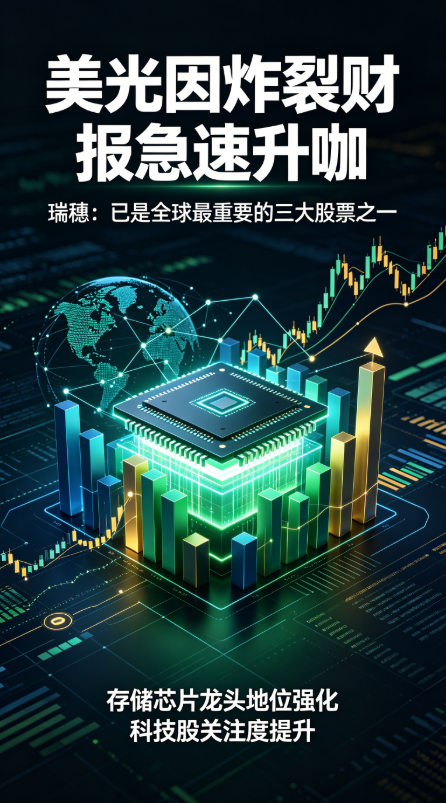
Micron Technology’s latest earnings report has done more than excite investors—it has reinforced a broader narrative about the transformation of the semiconductor industry in the age of artificial intelligence. After the company posted what Wall Street quickly labeled a “blockbuster” report, sentiment across the memory chip sector shifted sharply higher, and Micron’s market standing was elevated once again.
According to several Wall Street strategists, Micron is no longer viewed merely as a cyclical memory supplier. Instead, it is increasingly being treated as one of the most consequential companies in the global AI supply chain. The reason is clear: the explosive expansion of AI infrastructure is creating unprecedented demand for high-bandwidth memory, data center storage, and next-generation memory solutions, pushing Micron into a strategically vital position.
A Record-Setting Quarter Fueled by AI Demand
Micron’s latest results underscore how profoundly AI is reshaping the economics of the memory business. The company reported revenue growth of 346% year over year, while adjusted earnings per share rose more than twelvefold. Even more striking was its gross margin of 84.9%, a level that surpassed Nvidia’s and stood out as one of the strongest margins in the U.S. equity market.
Such performance would be remarkable in any environment, but it is especially significant for a company historically associated with a highly cyclical and often commoditized industry. Micron’s latest figures suggest that AI has changed the nature of demand in memory markets. Data centers are not just buying more memory; they are buying more advanced, more specialized, and more tightly integrated memory products that command pricing power and longer-term visibility.
This is exactly why the market reaction was so intense. Micron’s shares surged nearly 16% in Thursday trading, while related names such as SanDisk, Western Digital, and Applied Materials also moved higher. In other words, the earnings report did not just lift one stock—it triggered a broader reassessment of the entire semiconductor ecosystem tied to AI infrastructure.
From Commodity Producer to Strategic Supplier
Perhaps the most important message from Micron’s report is not contained in the headline numbers, but in the business model that appears to be emerging beneath them. Analysts at major banks argue that Micron is transitioning from a cyclical commodity producer into a strategic, contract-based supplier with much greater earnings durability.
Deutsche Bank analyst Melissa Weathers described the report as a meaningful strategic step, arguing that it helped convince investors Micron’s business model has fundamentally changed in the AI era. Her core point is that memory is no longer being treated purely as a price-sensitive commodity. In the current environment, it has become a strategic asset—one that powers the computational backbone of AI training and inference.
JPMorgan’s Harlan Sur echoed that view, noting that the expansion of strategic customer agreements represents a major shift. In his assessment, these agreements alter Micron’s profile by reducing dependence on short-term market swings and replacing them with longer-term supply commitments. That distinction matters. A business anchored by multi-year contracts can better plan capital expenditures, manage capacity, and sustain margins across cycles.
Micron disclosed 16 new strategic customer agreements spanning data centers, consumer markets, and automotive clients. The agreements include relationships with four hyperscale customers and three mid-sized clients, covering a planning horizon of three to five years. This kind of visibility is rare in the memory business and suggests that major customers are locking in supply well ahead of demand, reflecting both urgency and confidence in Micron’s product roadmap.
AI Infrastructure Is Still in Its Early Stages
The company’s management delivered another critical message during its earnings call: supply remains tight, and no one can confidently predict when memory output will fully catch up with surging demand. CEO Sanjay Mehrotra emphasized that the team currently cannot forecast when supply will be sufficient to meet rising AI-related needs.
That statement is important because it implies the current cycle may have more room to run. In past semiconductor upswings, supply additions often arrived quickly enough to pressure pricing and margins. This time, however, the AI buildout is so broad and capital intensive that demand may continue to outpace supply for an extended period.
From data centers to automotive systems, customers are increasingly requiring advanced memory solutions that support high-performance workloads. As AI models become larger and more complex, the need for bandwidth, efficiency, and reliability rises accordingly. This creates a favorable backdrop not only for Micron’s current products, but also for its next-generation offerings.
HBM4 Could Be the Next Catalytic Product
Another reason investors are growing more enthusiastic is Micron’s progress on HBM4, the next generation of high-bandwidth memory. Raymond James analyst Melissa Fairbanks praised the company’s achievements in this area, suggesting that the results are particularly encouraging because HBM4 is a critical component for leading AI chipmakers, including Nvidia.
HBM has become one of the most strategically important technologies in AI hardware. It enables faster data transfer, lower latency, and improved power efficiency—features that are essential for training large-scale AI models. As a result, companies that can deliver reliable HBM at scale are likely to enjoy strong pricing power and deep integration with the most advanced AI platforms.
Micron’s ability to advance in HBM4 is therefore not just a product milestone; it is a competitive signal. It indicates that the company is not merely benefiting from the AI boom passively, but actively positioning itself as a foundational supplier in the next generation of compute architecture.
Broader Implications for the Semiconductor Sector
Micron’s results also carry wider implications for the market. For years, memory stocks were often seen as highly cyclical, vulnerable to oversupply, and difficult to value with confidence. That framework may no longer be sufficient. As AI demand reshapes customer behavior and purchasing patterns, memory may increasingly resemble a strategic infrastructure layer rather than a standard industrial input.
This shift helps explain why analysts are using unusually strong language. One described the earnings as impossible to overstate in significance. Another said Micron’s performance was difficult to describe with any terminology other than exceptional. Such reactions are not typical for a memory company, which suggests the market believes something structural is changing.
If that interpretation proves correct, Micron could benefit from a multi-year rerating. A business supported by long-term agreements, disciplined supply, and premium AI products deserves a different valuation framework than a traditional cyclical manufacturer. The company’s latest report may therefore mark not just a strong quarter, but a turning point in how the market thinks about memory semiconductors.
Conclusion
Micron’s latest earnings report has become a defining event for the AI supply chain. The company delivered explosive growth, industry-leading margins, and a stronger long-term demand outlook than investors had expected. More importantly, it signaled that memory is evolving from a commodity business into a strategic pillar of AI infrastructure.
With long-term customer contracts in place, supply still constrained, and HBM4 development advancing, Micron appears well positioned to remain a major beneficiary of the AI investment cycle. For investors and industry observers alike, the message is clear: the memory market is no longer on the sidelines of the AI revolution—it is at its center.