Hormuz Strait Faces New Shock

A new security incident in the Hormuz Strait has disrupted vessel traffic again, reviving fears over oil prices, shipping delays, and energy market volatility.

2026.06.26 · 7 Reads
Hormuz Strait Faces New Shock
配图

Hormuz Strait Faces Fresh Disruption as Security Incident Reawakens Energy Market Fears

Keywords: Hormuz Strait, maritime security, oil prices, shipping disruption, Gulf tensions, IMO, energy markets

Introduction

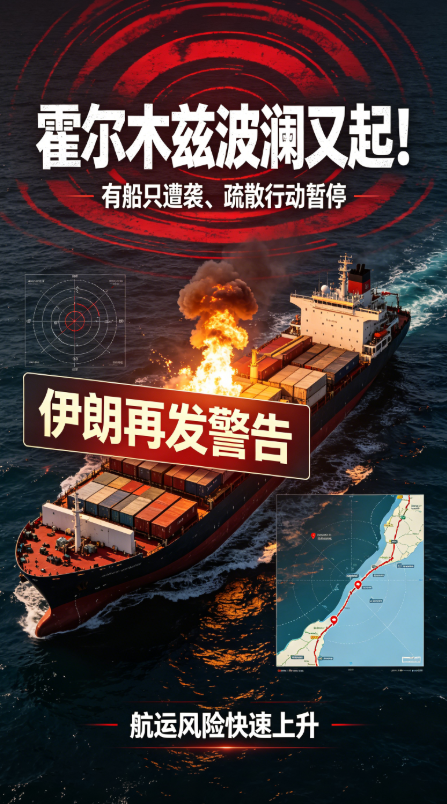
The maritime calm that began to return to the Hormuz Strait after the preliminary U.S.-Iran agreement has been sharply interrupted. In recent days, vessel traffic through the world’s most strategically important oil chokepoint had been recovering gradually. But on Thursday, a cargo ship was struck by an unidentified projectile in the Gulf of Oman, prompting the International Maritime Organization (IMO) to suspend the evacuation of stranded vessels through the strait.

The latest incident has once again exposed the fragility of navigation security in the region. Although no casualties or environmental damage were reported, the event has raised immediate concerns over the durability of the newly emerging transit arrangement and the wider implications for global energy markets. Brent and WTI crude prices both moved higher, with oil settling more than 2% up on the day.

A New Security Shock in a Critical Waterway

According to reports from the UK Maritime Trade Operations and other media outlets, a cargo vessel was hit by an unknown projectile near Omani waters, southeast of Duqm. The impact damaged the ship’s bridge but did not injure crew members. The vessel was still able to continue sailing, and no pollution was detected.

While some early reports suggested involvement by Iran’s Islamic Revolutionary Guard Corps, U.S. officials said it was too early to determine responsibility. Washington has launched an investigation into who carried out the attack and whether the action was ordered by senior IRGC leadership or conducted independently at a lower level. Regardless of attribution, the incident has already had a destabilizing effect: it reinforced the perception that the region remains vulnerable to sudden escalation.

For energy traders and shipping companies, the significance of the event lies not only in the damage itself, but in the timing. The attack occurred just as efforts were underway to restore confidence in safe passage through the strait. In that sense, it may prove more consequential than the physical damage suggests.

IMO Halts Evacuation Operations

In response to the attack, the IMO announced that it was suspending the evacuation of stranded vessels through the Hormuz Strait. The organization said it needed to verify whether the existing security guarantees and coordination mechanisms remained effective after the latest incident.

This pause highlights a fundamental challenge in maritime crisis management: even a single security incident can quickly undermine fragile confidence-building measures. The IMO and Oman had recently launched a new mechanism intended to help stranded ships and seafarers transit the strait safely. That system now faces its first major test.

The decision also underscores the broader reality that shipping security in the Gulf depends not only on formal agreements, but also on the perceived willingness of all parties to respect them. When that perception weakens, even a technically intact route may become commercially unusable because insurers, operators, and crews reassess the risks.

Iran’s Warnings Add Pressure to Maritime Traffic

Tensions were further amplified by repeated Iranian warnings that vessels must use designated routes and coordinate with Iranian authorities. Iranian officials have stated that ships deviating from approved lanes would face consequences and, according to the Revolutionary Guard’s naval branch, “will be dealt with.”

Earlier in the week, several tankers reportedly turned back after hearing warnings from the Iranian navy not to proceed. Iran’s maritime authorities later reiterated that all vessels passing through Hormuz must comply with prescribed routes and procedures, or lose security and insurance protection. The message was unambiguous: transit through the strait is not being treated as a purely international free passage zone, but as an area where Iran seeks direct regulatory influence.

This position creates a complex legal and political challenge. Under international maritime practice, the Hormuz corridor has long relied on recognized shipping lanes and coordination norms. Iran’s insistence on its own routing requirements introduces a layer of operational uncertainty, especially when the consequences for non-compliance are framed in both security and insurance terms. For shipowners, such ambiguity increases the cost of movement even before any physical threat materializes.

The Fee Dispute Reveals a Larger Power Struggle

Beyond immediate security concerns, the dispute over potential service fees adds a deeper political dimension to the crisis. Reports indicate that Iran has been actively lobbying for support for charging vessels passing through the strait for security and environmental services. According to media citing sources, Tehran estimates that such fees could generate tens of billions of dollars annually for the countries involved.

The United States has strongly rejected the idea. Secretary of State Marco Rubio stated that Gulf states offer “zero support” for the fee plan and emphasized that the waters of Hormuz do not belong to any single country. President Donald Trump also said that any maritime fee included in a final U.S.-Iran agreement would be unacceptable.

At the center of this debate lies a fundamental question: who effectively governs a maritime artery that is vital to the global economy? The current arrangement, under which Iran would allow ships to pass free of charge for 60 days, suggests that the issue remains unresolved. What happens after that period is still unclear, and that uncertainty could become a major source of market volatility in the weeks ahead.

Traffic Is Recovering, But Confidence Remains Fragile

Despite the renewed tension, vessel traffic through the Hormuz Strait has improved significantly over the past few days. According to Standard & Poor’s Global Commodity Insights, 78 ships passed through the strait on the 24th, the highest daily total since the outbreak of the conflict. Average daily traffic this month has recovered to about 57% of pre-conflict levels, and 551 vessels had transited by the 24th, putting the month on track to become the busiest since the war began.

These figures show that commercial activity is returning, but only partially. A recovery to just over half of normal levels is not a full normalization; it is a sign of cautious re-entry under persistent risk. Shipping companies may accept limited exposure when oil prices are favorable or cargo commitments are urgent, but they remain highly sensitive to any sign that the security environment is deteriorating again.

In practical terms, a single attack can reverse days or weeks of progress. Insurance premiums rise, voyage planning becomes more conservative, and some operators may choose alternative routes or delay sailings. The result is that even a relatively contained incident can ripple across freight markets and energy pricing.

Conclusion

The latest incident in the Gulf of Oman demonstrates how quickly the Hormuz Strait can shift from cautious stabilization back to acute uncertainty. Although the cargo ship attack caused no casualties and limited physical damage, its strategic impact is considerable. It has prompted the IMO to suspend evacuation operations, renewed doubts about the durability of the maritime security arrangement, and revived fears of disruption in a waterway through which a substantial share of global energy supplies flows.

The broader lesson is clear: the Hormuz Strait is not only a geographic chokepoint but also a geopolitical pressure point. Its stability depends on fragile coordination among rivals, and any breakdown in that coordination has immediate consequences for global markets. As traffic recovers only partially and the 60-day free passage arrangement remains temporary, the coming weeks will be decisive in determining whether the region moves toward a durable maritime order or another cycle of disruption.

Related Articles