


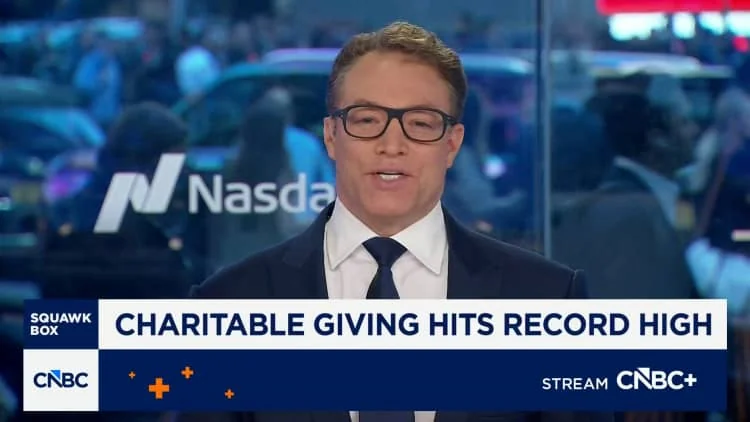
U.S. charitable giving tops $600 billion for the first time: market and bequest effects
According to the Giving USA report, U.S. charitable giving was estimated at $617.2 billion last year, up 5.7% from the prior year. The increase came amid a strong stock-market rebound. The report was released by the Giving USA Foundation.
The findings mark the first time in the 60-year history of the annual report that total giving has topped $600 billion. Adjusted for inflation, donations rose 3% year over year.
Stock gains helped big donors more than everyone else
Although the market rally lifted overall giving unevenly, the effect was stronger among donors with more money to give. Individual giving still accounted for the largest share of total giving at $394.2 billion, but rose only 1.4% after inflation. At the same time, bequests were estimated to rise 16.6% to $62.19 billion.
The rise in bequests may be a new signal of the “Great Wealth Transfer.” Cerulli Associates estimates that more than $124 trillion in assets will pass by inheritance by 2048, with about $18 trillion planned for charity.
Lead analyst Jon Bergdoll said it is still not clear how much of the rise in bequests comes from the massive wealth handoff itself.
What is clearer, Bergdoll said, is that wealthy Americans most likely to leave large sums to charity are also the biggest beneficiaries of the stock market’s gains.
“There is usually a fairly tight link between bequests and net worth overall, and net worth is tied to market performance,” Bergdoll said. He is data and research collaboration lead and interim director at the Indiana University Lilly Family School of Philanthropy, which researches and writes the report.
Overall giving reacts more slowly to stocks: avoid a too-tight link
Overall giving also includes foundation and corporate donations. Bergdoll said the stock market affects that broader pool more slowly and more gently. He said he would have expected a bigger increase after several years of strong market growth.
The report said the S&P 500 rose 13.4% after inflation between 2024 and 2025, while total giving grew at only about a quarter of that pace.
Bergdoll attributed part of the gap to sluggish GDP growth and consumer confidence at historic lows.
“This is a somewhat unusual economic environment to support stock-market growth. Even though market performance is good and GDP is fine, there still seems to be a lot of unease. We know people give from a place of financial security, so that may be a drag on giving at the individual level,” Bergdoll said.
He added that if charitable giving becomes too closely tied to stock-market swings, the nonprofit sector would suffer. “We don’t want a one-to-one relationship. Of course, we may want giving to rise 20% when the market rises 20%, but we don’t want it to fall 20% when the market falls 20%.”
Tax incentives and ultra-wealthy dependence: bequests and megagifts reshape the year
The report said many high-income people are expected to accelerate giving in 2025 to take advantage of tax breaks. But due to changes tied to the One Big Beautiful Bill Act, some tax benefits will decline. Bergdoll said the boost from front-loading gifts is meaningful, but still modest relative to total giving. The report estimates donors gave an extra $1.71 billion in 2025 to better use tax incentives that are about to expire.
Although U.S. charities received more money, the report also says their dependence on ultra-high-net-worth donors is deepening because economic pressure is squeezing middle-income donors. The report estimates that just nine donors contributed $22.32 billion of total giving last year, with Mackenzie Scott, the former wife of billionaire Jeff Bezos, contributing the largest share at $6.65 billion.
These megagifts, defined as donations equal to at least 0.1% of total giving, can significantly reshape the charitable landscape from year to year. The report also said nearly one-third of the increase in bequests came from the estate of late Microsoft co-founder Paul Allen, which established a $3.1 billion fund for science and technology research.
Gabe Cooper, vice chair of the Giving USA Foundation, had mixed feelings about megagifts. He said: “Of course I want wealthy people like Paul Allens and MacKenzie Scotts to put more of their wealth into charity. I also want more billionaires to do that. But on the other hand, I don’t want that number to grow too much. I don’t want philanthropy to become increasingly dependent on the ultra-wealthy, because their giving can swing much more from year to year.”
Cooper also focused on heirs. He said that if a billionaire dies and gives $200 million to charity, the other $800 million will probably go to the children; so he wants those heirs to make better decisions about philanthropy.